Most business owners know when they have a marketing problem, but they do not always know what kind of marketing problem it is.
The phone is not ringing enough. The website gets visitors but not enough leads. Ads are spending money without clear results. Social media feels busy but not productive. SEO sounds important, but it is hard to know where to start.
When this happens, the natural response is to look for another tactic.
Maybe we need more traffic. Maybe we need to post more. Maybe we need to run ads. Maybe we need a new website. Maybe we need better SEO.
Any of those could be true. But before you spend more money or add another task to your plate, it helps to identify the real marketing problem.
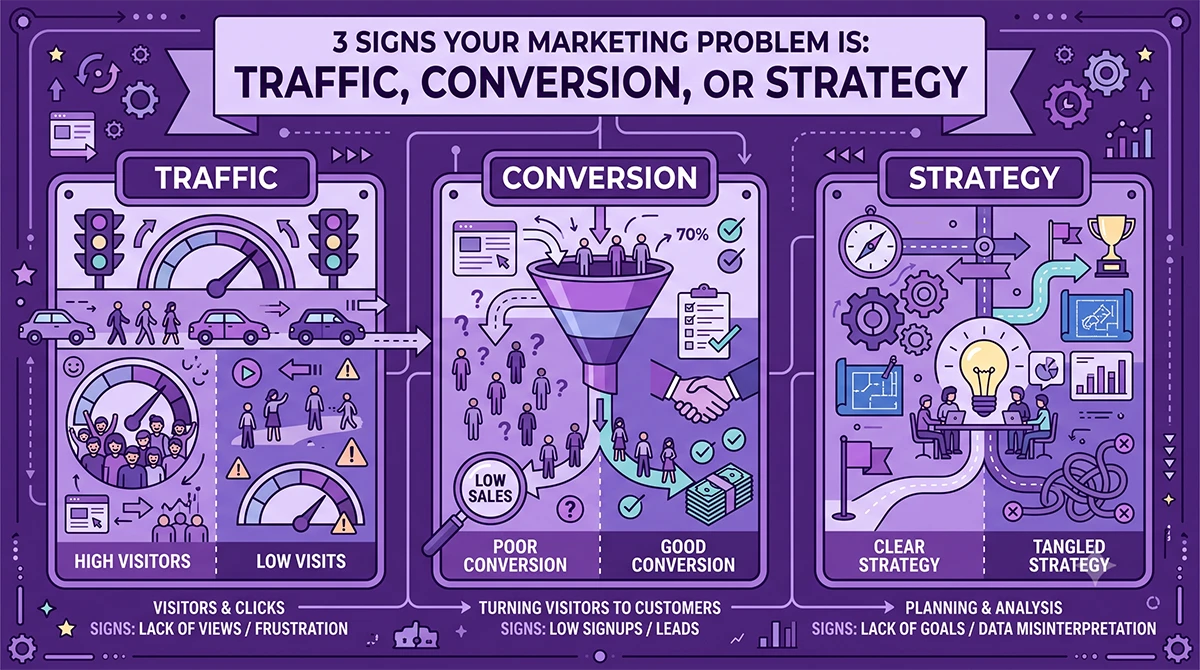
Most marketing problems fall into three main categories. Naming the right marketing problem is the first step toward fixing it:
- Traffic problem
- Conversion problem
- Strategy problem
Sometimes there is a fourth issue that affects results as well: follow-up. A business may be generating leads, but if those leads are not handled quickly and consistently, marketing may get blamed for what is really a sales process or communication issue.
The point is simple: different problems need different solutions.
More traffic will not fix an unclear website. A new website will not fix a weak offer. Paid ads will not fix broken tracking. More content will not fix a lack of strategy. Better SEO will not help much if visitors cannot understand why they should contact you.
When you know which marketing problem you are dealing with, your next step becomes much clearer. The goal is not to make the marketing problem sound complicated. The goal is to make the decision easier.
First, Identify the Real Marketing Problem
Before choosing a marketing tactic, ask a better question:
“What is actually broken?”
That question matters because each marketing problem needs a different solution.
If the right people are not finding your business, you may have a traffic problem.
If people are visiting your website or seeing your offer but are not taking action, you may have a conversion problem.
If you are doing a lot of marketing activity but still feel unclear, scattered, or reactive, you may have a strategy problem.
Many businesses skip this step. They jump straight into action because action feels productive. But activity without diagnosis can waste time, budget, and energy.
For example, a business owner may think, “We need more leads, so let’s run ads.”
That might be the right move. But what if the business already has website traffic and the real marketing problem is that visitors are not converting? In that case, paid ads may only send more people to a page that is not doing its job.
Another business may think, “We need a new website.”
That might also be true. But what if the website is acceptable and the real marketing problem is low visibility, unclear content, and no consistent way to attract qualified traffic? In that case, the website may only be one part of the issue.
Another business may think, “We need SEO.”
Again, that may be right. But if the business has weak service pages, poor tracking, vague calls to action, and no clear priority around which services matter most, SEO alone will not solve the full marketing problem.
Better marketing starts with clearer thinking.
Why Misdiagnosing a Marketing Problem Gets Expensive
Marketing gets expensive when a business keeps fixing the wrong thing.
A company may spend thousands of dollars on ads when the real issue is a weak landing page. Another may redesign a website when the real issue is low visibility. Another may publish blog posts for months without first optimizing the service pages that should be doing most of the selling.
This is why a practical diagnosis matters.
When you identify the right marketing problem, you can make better decisions about:
- Where to spend money
- What to fix first
- Which channels deserve attention
- What to measure
- What to pause
- What to improve before scaling
- Whether you need execution, strategy, or both
Small and mid-sized businesses usually do not have unlimited marketing budgets. That makes prioritization even more important.
The goal is not to do everything. The goal is to do the right things in the right order.
That is why this article is built around a simple framework: traffic, conversion, strategy, and follow-up.
Sign 1: You Have a Traffic Problem
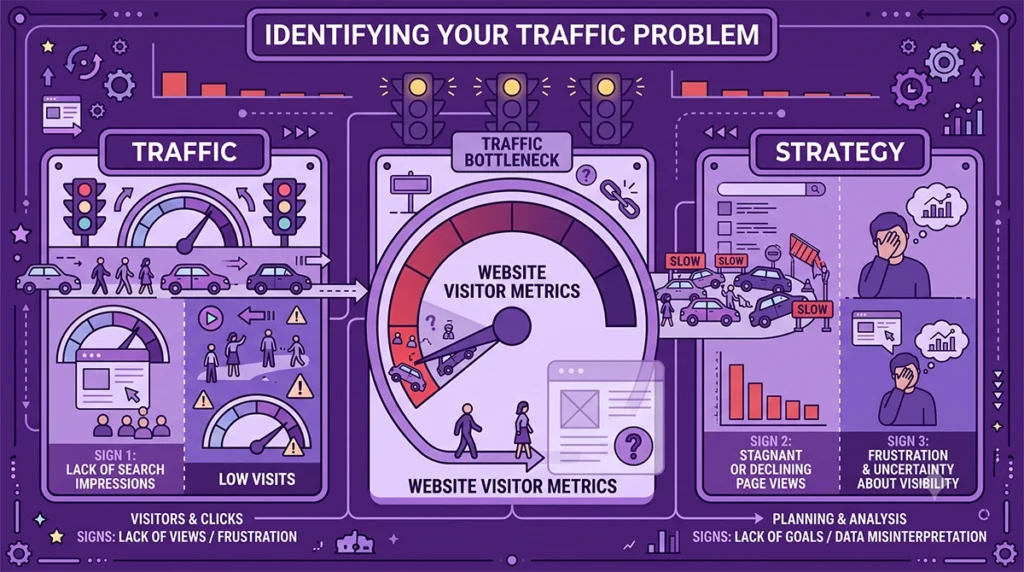
A traffic problem means not enough of the right people are seeing your business.
This marketing problem is really a visibility issue. If this is your main marketing problem, your first priority is getting in front of the right people.
This does not simply mean you need more website visitors or more social media followers. It means your business is not visible enough to people who are likely to need, want, or search for what you offer.
You may have a traffic problem if:
- Your website gets very few visitors
- Your Google Business Profile gets little visibility
- Competitors show up above you in local search
- Your service pages do not rank for relevant searches
- Your business depends heavily on referrals only
- You have a good offer, but not enough people know about it
- Your ads are not reaching the right audience
- Your content is not connected to what customers are actually looking for
- You rarely get inquiries from people who found you online
- Your website analytics show low search traffic
For local service businesses, traffic often comes from search visibility, Google Business Profile activity, paid ads, referrals, social media, and local awareness. The right mix depends on your market, budget, service area, and business goals.
This marketing problem is especially important for businesses that rely on high-intent searches. If someone searches for a roofer, dentist, attorney, HVAC company, accountant, contractor, or local service provider, they are usually looking for help now or soon. If your business is not visible in those moments, competitors may get the opportunity first.
What to Check if Traffic Is the Marketing Problem
Start with basic visibility questions.
Can people find your business when they search for your main services?
Do your service pages clearly explain what you do?
Does your website have pages for your most important services?
Is your Google Business Profile complete, accurate, and active?
Are you showing up in the locations you actually serve?
Are you creating content around real customer questions?
Do your paid ads reach people with buying intent?
Are you tracking where your website visitors come from?
A traffic problem can come from several places. This type of marketing problem can be caused by weak SEO, poor local visibility, unclear service pages, or unfocused ads. Your website may not have enough optimized pages. Your local SEO may be weak. Your content may not match what people search for. Your Google Business Profile may be underdeveloped. Your paid ads may be targeting too broadly. Your service pages may not be clear enough for search engines or users.
Google’s SEO Starter Guide explains that SEO should make it easier for search engines to crawl, index, and understand your content. That is one reason your service pages, site structure, and content clarity matter.
For local businesses, your Google Business Profile also matters. Google’s Business Profile Help Center provides guidance on claiming, managing, and improving your profile so customers can find accurate information about your business.
Traffic problems are often connected to SEO, paid advertising, content strategy, and local visibility. When visibility is the marketing problem, the solution should focus on attracting qualified attention, not just more traffic.
What to Fix First for a Traffic Problem
If traffic is the marketing problem, start by reviewing your visibility foundation.
Ask:
- Which services do we most want to be found for?
- Which locations matter most?
- Which searches show buying intent?
- Which pages should rank for those searches?
- Are those pages strong enough?
- Is our Google Business Profile helping or sitting unused?
- Are our ads focused or too broad?
- Are we measuring traffic quality, not just traffic volume?
Traffic matters, but the quality of traffic matters more.
Getting more visitors is not helpful if they are the wrong visitors. A local service business does not need random website traffic from across the country. It needs relevant traffic from people in the right market who need the right service.
For more on local visibility and overlooked lead-generation tools, read 5 Lead-Generation Tools That Small Businesses Are Under-Using in 2025.
More traffic only helps if the rest of your marketing is ready to convert that attention into action.
Sign 2: You Have a Conversion Problem
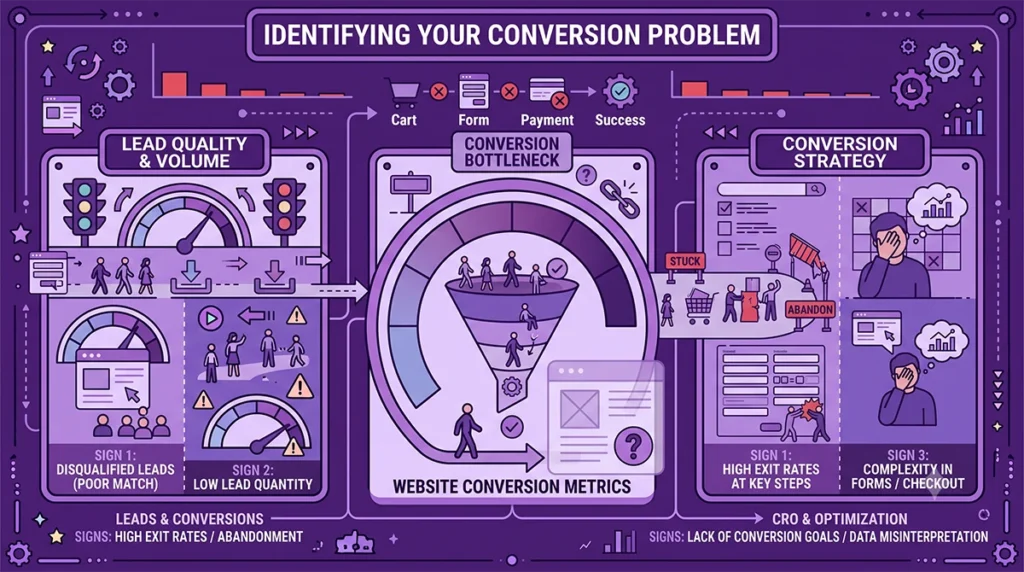
A conversion problem means people are seeing your business, but they are not taking the next step.
This marketing problem usually appears after a business has some visibility. People may visit the website, click ads, view a Google Business Profile, or engage with content, but those actions do not turn into enough calls, form submissions, appointments, or sales conversations.
You may have a conversion problem if:
- Your website gets traffic but few inquiries
- People click your ads but do not become leads
- Your contact form is rarely completed
- Visitors leave quickly after landing on your site
- Your calls to action are vague or hard to find
- Your service pages are thin or unclear
- Your offer is not easy to understand
- Your website looks fine but does not build trust
- People ask basic questions that your website should already answer
- Your landing pages do not match your ads
- Mobile visitors are not taking action
- Your phone number or contact options are hard to find
A conversion problem is not always a design problem. Sometimes the site looks professional but still fails because the message is unclear, the structure is confusing, or the next step is hidden.
A strong website should help visitors quickly understand:
- What you do
- Who you help
- What problem you solve
- Why they should trust you
- What they should do next
If those answers are unclear, more traffic may only send more people into confusion. That is why this marketing problem should be addressed before scaling traffic.
This is why a website can be part of the marketing problem even if it looks professional.
Why Conversion Problems Are So Common
Many websites are built around the business, not the customer.
They talk about the company, the history, the services, and the team, but they do not guide the visitor through a clear decision-making path.
A potential customer usually comes to your website with practical questions:
- Can this company solve my problem?
- Do they serve my area?
- Do they work with businesses or people like me?
- Are they credible?
- What does the process look like?
- How do I contact them?
- What happens after I reach out?
If your website does not answer those questions clearly, visitors may leave without taking action.
This is why a good-looking website can still have a marketing problem. Design matters, but design alone does not create clarity, trust, or conversion.
For more on this, read Why Most Small Business Websites Fail to Generate Leads.
What to Check if Conversion Is the Marketing Problem
Start with your homepage and your most important service pages.
Ask:
- Is the headline clear?
- Can a visitor understand what we offer within a few seconds?
- Are our services easy to find?
- Do our pages explain who we help?
- Do we show proof, reviews, examples, or credentials?
- Are our calls to action specific?
- Is the contact process simple?
- Does the site work well on mobile?
- Are our forms easy to complete?
- Does each page guide the visitor toward a next step?
- Does the page answer common objections?
- Does the page match the promise made in our ads, emails, or social posts?
Conversion problems are often connected to web design, copywriting, landing pages, offer clarity, trust signals, and follow-up. When conversion is the marketing problem, your website and landing pages need closer attention.
Before increasing ad spend or chasing more visibility, make sure your website and landing pages are ready to turn attention into action.
What to Fix First for a Conversion Problem
If conversion is the marketing problem, review the customer journey.
Look at the path from first visit to inquiry.
For example, a potential customer may:
- Search for a service on Google
- Click your website
- Land on a service page
- Skim the headline and first few sections
- Look for proof that you can help
- Check your location or service area
- Compare you with competitors
- Decide whether to call, fill out a form, or leave
Every step either builds confidence or creates friction.
If the message is unclear, confidence drops. If the page is hard to navigate, friction increases. If the call to action is hidden, people may not act. If trust signals are missing, they may keep comparing. If the mobile experience is poor, they may leave.
Improving conversion does not always require a full website redesign. Sometimes it starts with clearer headlines, stronger service pages, better calls to action, better proof, and a simpler contact path.
If your website is the weak point, review 828 Biz’s web design and development services to see how a stronger website can support clarity, trust, SEO, and lead generation.
Sign 3: You Have a Strategy Problem
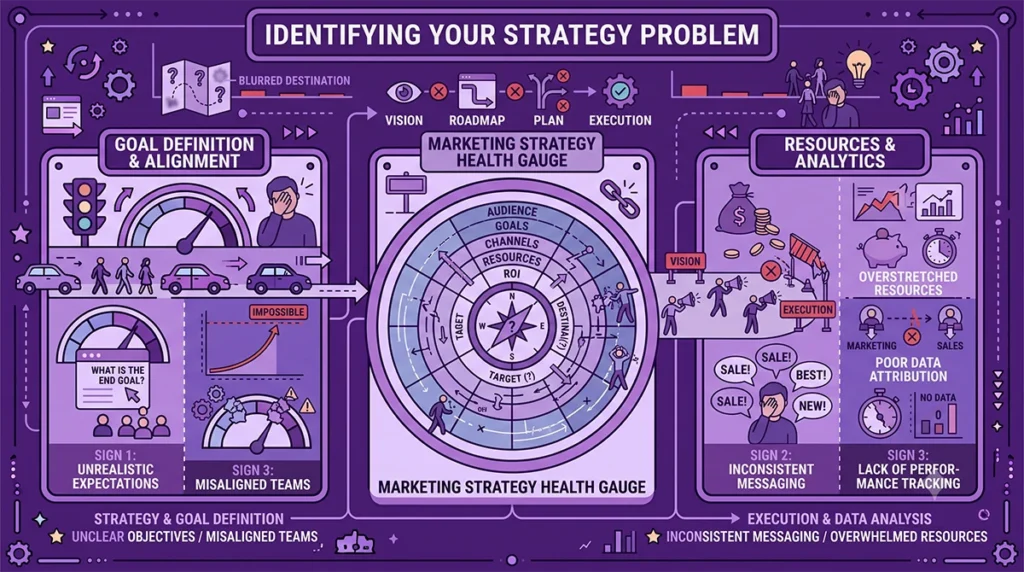
A strategy problem means your marketing activity is not clearly connected to your business goals.
This marketing problem is one of the most common issues small business owners face. The business may be posting on social media, running ads, updating the website, sending emails, trying SEO, creating content, and testing tools, but nobody is sure what matters most.
The work is happening, but the direction is unclear.
You may have a strategy problem if:
- You are doing marketing but cannot explain the main goal
- Every new idea feels urgent
- You change direction often
- Your team or vendors are not aligned
- You are spending money but do not know what is working
- You have reports but no clear decisions
- You are trying to do too many things at once
- You are unsure whether to focus on SEO, ads, website improvements, email, or social media
- You feel responsible for marketing, but do not have time to lead it well
- You start campaigns without knowing how success will be measured
- You have multiple tools, vendors, or platforms but no clear roadmap
- You are reacting to trends instead of following a plan
A strategy problem can make every tactic less effective. This marketing problem often shows up when a business has activity but no clear priority.
SEO needs a strategy. Paid ads need a strategy. A website redesign needs a strategy. Content needs a strategy. Even social media needs a reason for existing beyond “we should probably post something.”
Without strategy, marketing becomes reactive. If this is your marketing problem, adding another tactic may create more confusion, not more progress.
Why Strategy Problems Create So Much Confusion
Marketing has more options than most business owners can reasonably manage.
You can work on your website, SEO, Google Ads, Meta Ads, email marketing, local listings, social media, video, content, automation, reviews, branding, analytics, and more.
The problem is not that these options are bad. Many of them can be useful.
The problem is that not every option deserves the same priority at the same time.
A business with weak service pages may need website and SEO work before a large content push.
A business with strong search visibility but poor lead conversion may need website improvements before more traffic.
A business with a clear offer and strong landing page may be ready for paid ads.
A business with scattered vendors and no plan may need strategic leadership before adding another channel.
Strategy helps decide what matters now, what can wait, and what should be ignored.
That is often the real marketing problem: not a lack of options, but a lack of priority.
What to Check if Strategy Is the Marketing Problem
If strategy is the marketing problem, pause before adding more activity.
Ask:
- What business goal are we trying to support?
- Which services, offers, or locations matter most right now?
- Who are we trying to reach?
- What does the buyer need to understand before contacting us?
- Which channels make the most sense for this audience?
- What budget and internal capacity do we actually have?
- What should we measure?
- What should we stop doing for now?
- Who is responsible for marketing decisions?
- Are our vendors or internal team members working from the same plan?
- Are we measuring activity or actual business outcomes?
Strategy helps you decide what to prioritize and what to ignore.
That is important because most small businesses do not have unlimited time, budget, or attention. You do not need to do everything at once. You need to do the right things in the right order.
For a broader planning perspective, read How to Turn Q4 Momentum into a Strong 2026 Marketing Plan.
Paid Ads Can Reveal a Marketing Problem Quickly
Paid advertising can be useful because it gets traffic moving faster than many organic channels. But that speed also means paid ads can reveal a weak foundation quickly.
If the offer is unclear, ads will expose it. If the landing page is weak, ads will expose it. If tracking is missing, ads will expose it. If follow-up is slow, ads will expose it. If the audience is wrong, ads will expose it.
That does not mean paid ads are bad. It means paid ads need the full system to work.
Google’s guide to conversion measurement in Google Ads explains that conversion measurement helps identify which ads, keywords, ad groups, and campaigns are driving valuable customer activity. That kind of tracking matters because clicks alone do not tell the whole story.
A paid ads campaign should be judged by more than impressions or clicks. It should be connected to business goals, lead quality, landing page performance, and follow-up.
If you are deciding between paid ad platforms, read Meta Ads vs. Google Ads in 2025: Avoid This Costly Mistake with Your Ad Strategy.
The wrong ad platform is not always the marketing problem. Sometimes the issue is the offer, the page, the budget, the tracking, or the follow-up process.
Do Not Overlook the Follow-Up Problem
Sometimes the marketing is doing its job, but the lead handling process is weak.
This is not always treated as a marketing problem, but it affects marketing results.
You may have a follow-up problem if:
- Leads are not contacted quickly
- Calls are missed during business hours
- Form submissions sit too long before someone responds
- There is no clear sales process
- Leads are not tracked after they come in
- No one knows which leads became customers
- The team does not consistently follow up with estimates or proposals
- Good leads are lost because communication is slow or unclear
This matters because marketing does not end when someone fills out a form.
For many businesses, the gap between lead and customer depends on response time, communication quality, sales process, and follow-through.
If a business spends money on SEO, PPC, or a website but does not handle leads well, the marketing may look worse than it really is.
What to Fix First for a Follow-Up Problem
If follow-up is part of the marketing problem, review the process after the lead comes in.
Ask:
- Who receives the lead?
- How quickly do they respond?
- What happens if the lead calls after hours?
- Are form submissions tracked?
- Is there a standard follow-up process?
- Are estimates, proposals, or appointments followed up on consistently?
- Do we know which channels produce customers, not just leads?
Better marketing should connect to better follow-up. Otherwise, good opportunities can be lost after the inquiry.
Google Analytics can also help businesses measure important actions across channels. Google’s information on Analytics conversions explains how important actions can be marked and measured, which can help businesses better understand what people do after interacting with their marketing.
Measurement does not solve every marketing problem, but it can help you stop guessing.
Sometimes You Have More Than One Marketing Problem
Marketing problems are not always clean and separate.
A business may have a traffic problem and a conversion problem.
For example, a local contractor may not be ranking well in Google and also have a website that does not clearly explain services, service areas, or next steps.
A business may have a conversion problem and a strategy problem.
For example, a professional service provider may be getting website traffic but sending visitors to vague pages while also running disconnected campaigns without clear goals.
A business may have a traffic problem and a strategy problem.
For example, a company may want more visibility but have no clear decision about which services, locations, or customer segments should be prioritized.
A business may have a follow-up problem layered on top of everything else.
For example, a company may generate leads from SEO or paid ads, but if the team does not respond quickly, those leads may not become customers.
A business may even have all four issues at once.
That is why diagnosis matters. The same marketing problem can show up in different ways depending on the business, the channel, and the customer journey. The goal is not to label the problem perfectly. The goal is to identify the highest-priority constraint.
In plain English: what needs to be fixed first?
A Simple Marketing Problem Diagnostic
Here is a practical way to think through your next move.
If not enough people are finding you, focus on traffic.
Possible next steps:
- Improve SEO
- Strengthen local search visibility
- Optimize your Google Business Profile
- Build stronger service pages
- Run focused paid ads
- Create content around real customer searches
- Improve local listings and online visibility
- Build a content plan around buyer questions
This is usually the right focus when your business is not getting enough qualified attention.
If people are finding you but not contacting you, focus on conversion.
Possible next steps:
- Improve website messaging
- Clarify your offer
- Strengthen calls to action
- Add trust signals
- Improve landing pages
- Simplify forms
- Improve mobile usability
- Review the follow-up process
- Rewrite service pages
- Make the next step more obvious
This is usually the right focus when your business has visibility but not enough leads.
If you are doing a lot but still feel scattered, focus on strategy.
Possible next steps:
- Clarify business goals
- Define marketing priorities
- Review channel performance
- Build a simple roadmap
- Align budget with goals
- Decide what to pause
- Get strategic leadership or Fractional CMO support
- Improve reporting and accountability
- Connect marketing activity to business outcomes
This is usually the right focus when your business has activity but not direction.
If leads are coming in but not becoming customers, review follow-up.
Possible next steps:
- Improve response time
- Track leads by source
- Create a follow-up process
- Review call handling
- Improve appointment-setting steps
- Track close rates
- Align marketing and sales communication
This is usually the right focus when marketing is creating opportunities but those opportunities are not being handled consistently.
What Data Should You Review?
You do not need to become a full-time analyst to understand your marketing problem. But you do need to look at the right signals.
Useful places to review include:
- Website traffic
- Traffic sources
- Form submissions
- Phone calls
- Google Business Profile activity
- Keyword visibility
- Ad campaign performance
- Landing page performance
- Conversion rates
- Lead quality
- Close rates
- Customer source data
The goal is not to collect data for the sake of data. The goal is to make better decisions.
For example, if website traffic is low and rankings are weak, visibility may be the first issue.
If website traffic is steady but inquiries are low, conversion may be the first issue.
If leads are coming in but few become customers, follow-up or lead quality may need attention.
If every channel is active but no one can explain what is working, strategy may be the issue.
Good data helps you stop guessing.
Common Mistakes Business Owners Make When Diagnosing a Marketing Problem
Mistake 1: Assuming More Traffic Is Always the Answer
More traffic can help, but only if the website, offer, and follow-up process are ready.
If your site does not clearly explain what you do, more visitors may not lead to better results. In that case, traffic is not the only marketing problem.
Mistake 2: Blaming the Channel Too Quickly
Sometimes business owners say, “Google Ads does not work,” or “SEO does not work,” or “Social media does not work.”
The channel may not be the problem. The issue may be strategy, targeting, offer clarity, landing page quality, tracking, budget, or follow-up.
Mistake 3: Redesigning the Website Without Fixing the Message
A new design can help, but design should support clear communication.
If the message is still vague after the redesign, the website may look better without performing better. The marketing problem may still be unclear positioning, weak service pages, or poor calls to action.
Mistake 4: Publishing Content Without a Plan
Blogging can support SEO, but random content does not equal a strategy.
Content should connect to real customer questions, service priorities, search intent, and internal linking.
Mistake 5: Measuring Activity Instead of Outcomes
Posting more, spending more, or getting more clicks does not automatically mean marketing is working.
Marketing should be evaluated by useful business outcomes, such as qualified leads, better visibility, stronger conversion, and clearer decision-making.
Do Not Spend More Until You Know What Needs Attention First
More traffic will not fix an unclear website.
A new website will not fix a weak offer.
Paid ads will not fix broken tracking.
More content will not fix a lack of strategy.
Social media will not fix unclear positioning.
Every marketing channel works better when the foundation is stronger. That does not mean everything has to be perfect before you take action. It means your next step should match the real constraint.
If the issue is visibility, invest in getting found.
If the issue is conversion, improve the message, website, and user journey.
If the issue is strategy, get clear before spending more.
If the issue is follow-up, tighten the process after the lead comes in.
The right next step depends on the real marketing problem. Once the marketing problem is clear, your next decision becomes more practical.
Final Thought
Small business marketing does not need to be complicated, but it does need to be clear.
When marketing feels frustrating, the answer is not always to do more. Sometimes the better move is to step back and ask what kind of marketing problem you are really dealing with.
Is it traffic? Is it conversion? Is it strategy? Is it follow-up?
Once you know that, the next step becomes easier to choose.
At 828 Biz Marketing, we help business owners look at what is working, what is not, and what marketing moves make the most sense next. Whether your business needs a stronger website, better SEO, more effective paid advertising, or strategic marketing leadership, the first step is getting clear on the real problem.
If you are not sure what kind of marketing problem is holding your business back, schedule a free 20-minute consultation with 828 Biz. A short strategy conversation can help you identify whether the issue is traffic, conversion, strategy, follow-up, or something else that needs attention first.